
Disclaimer: This review is based on publicly available information; the Trustpilot figures were checked on September 19, 2026 and vendor prices on the dates shown in the pricing table. Features, pricing, and capabilities may have changed. We encourage readers to verify current details directly with the vendor.
DeepCura publishes this review and sells a competing product. Where Heidi fits a practice better we say so; every price carries the date it was verified, and the Trustpilot rating is quoted as shown on Trustpilot on the date stated.
$150/month. 110+ languages. 116 countries. That is Heidi AI — the AI scribe from Heidi Health — in a nutshell: the category leader in multilingual ambient documentation, now priced above full-platform alternatives.
Here is what Heidi Health does and does not do:
- Does: Multilingual ambient documentation in 110+ languages, localized Australian Medicare / UK NHS / US note formats, deep field-by-field template customization, and an expanding module set (Heidi Comms, Heidi Evidence, AI coding, push-to-chart)
- Does not: Turn what was said into a coded, evidence-linked patient chart (structured output ends at the note), process inbound faxes, put fax + email + phone + SMS in one AI-cleared queue, EHR write-back outside the Enterprise tier, real-time SMS during AI calls, patient intake automation
- Best for: International and multilingual practices for whom 110+ language documentation is the deciding requirement
- Not for: Practices that want the visit itself to update the chart — coded entries, trends, population queries — or US practices that need platform breadth, at a lower price, on one shared context
Two gaps matter more than note quality in 2026, and Heidi's $150/user/month price tag sits above a platform that closes both:
- Heidi writes the note — beautifully, in 110+ languages. DeepCura's scribe writes the chart — every value spoken aloud becomes a coded, evidence-linked entry you approve, then a trend, then a practice-wide query.
- Heidi's modules each produce their own output. DeepCura's agents share one. Fax, email, phone, and SMS land in a single AI Inbox where an agent proposes every disposition at once — priced, checkable, and executed only after you confirm — reading the same patient context the scribe just wrote.
Heidi is assembling products. DeepCura is assembling one context that its agents work inside.
This review is an honest assessment of Heidi Health in 2026. We cover what it does well, where it falls short, who should consider it, and who might be better served by a different platform.
The Ambient Data Gap — Heidi Writes the Note; DeepCura Writes the Chart
Heidi's 2026 expansion is real — but notice what every new module orbits: the note. Push-to-chart moves the finished note into EHR sections. AI coding suggests ICD-10 and SNOMED-CT codes for the encounter (on Enterprise). The structured chart underneath — problem list, med list, flowsheet trends — is still maintained by hand, and the value spoken aloud in the room ("her A1c came back at 7.2") stays prose.
DeepCura's Ambient Data, launched in July 2026, produces a different kind of output. The scribe stages coded chart entries from the conversation itself: a mentioned diagnosis stages as an ICD-10-coded problem, a spoken lab value as a LOINC-coded series point, and a med change as a real status change — approving a "stopped the metformin" card records a stop on the med list, not a sentence about one. Every AI-suggested code is verified against DeepCura's built-in terminology engine (ICD-10-CM, LOINC, RxNorm, SNOMED CT) before it reaches you, and nothing commits without your approve, edit, or reject.
The structural difference is the evidence trail. Every staged entry carries the verbatim quote and the exact second of visit audio behind it — click and replay the moment it was said. Heidi does not store audio after transcription — a deliberate privacy posture, but it means a finished note can never show you what the AI actually heard. DeepCura keeps the receipt on every committed value.
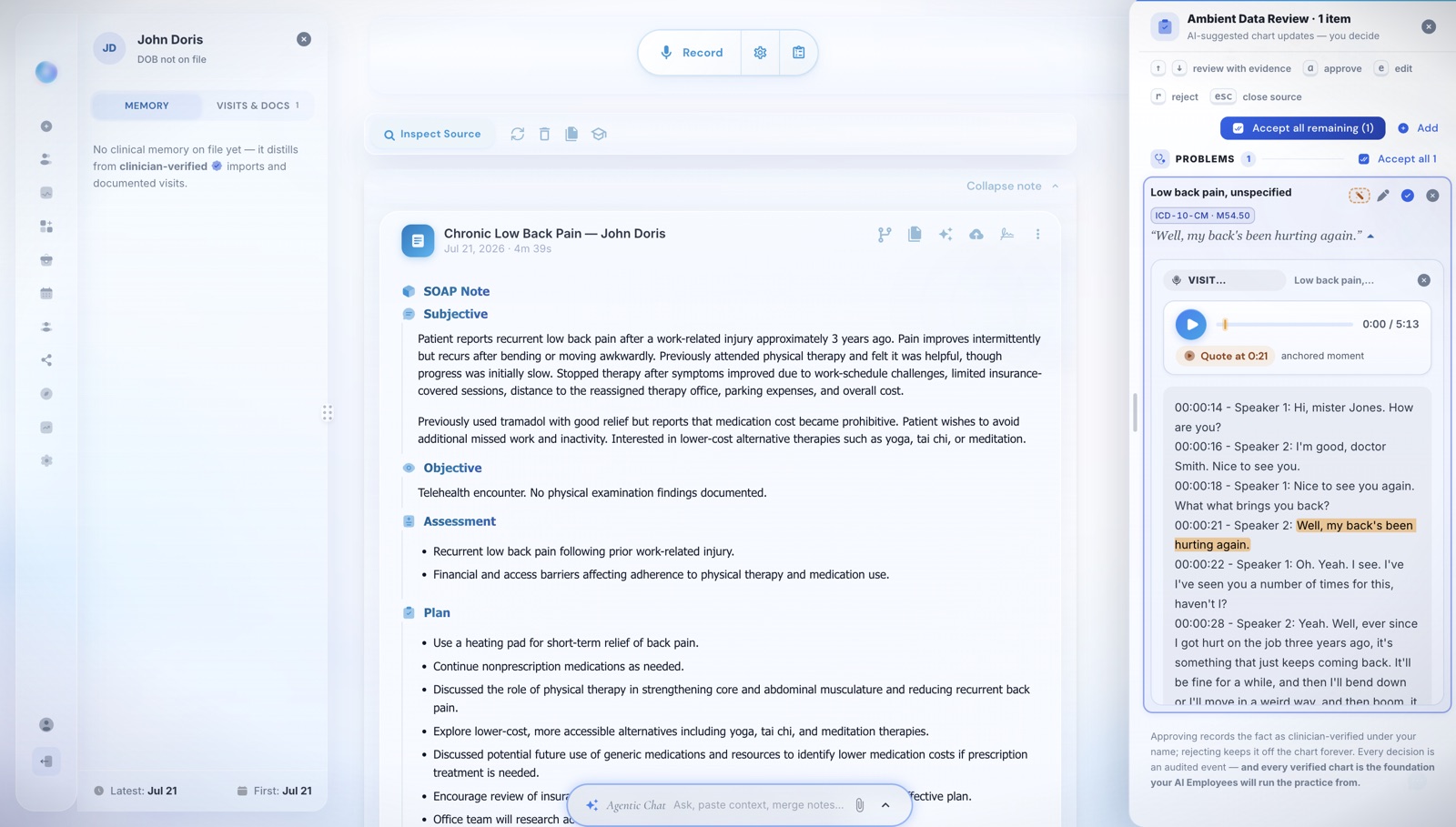
The Ambient Data review panel — a staged problem card (ICD-10-CM · M54.50) carrying the verbatim quote "Well, my back's been hurting again," anchored to second 0:21 of the visit audio. Nothing commits without the clinician.
From there, the data compounds:
- Custom Ambient Trackables — track anything (pain per joint, PHQ-9, injection units per site) and the scribe captures it from conversation at every visit. Say it once, tracked forever.
- An always-current picture before every follow-up — problems, meds, allergies, and trends assembled for you, so pre-charting stops being a 7 AM chart-archaeology session: you review the handful of things that changed, not the whole ocean.
- Population Panels — "every patient whose latest A1c is above 9," the overdue list, lost-to-follow-up: one query across the whole practice, evidence attached to every result, CSV export for outreach. As of July 2026, DeepCura is the first US system that turns conversations into population-level data — the chart writes itself, every value carries its evidence, every entry approved by you.
- Faxes feed the same chart — an inbound fax is summarized, auto-matched to the patient (MRN first, then phone plus date of birth, then name; an ambiguous match is surfaced, never guessed), and once paired its contents stage as chart suggestions anchored to the highlighted PDF line and conflict-checked against the live chart. Heidi offers no inbound fax processing at all.
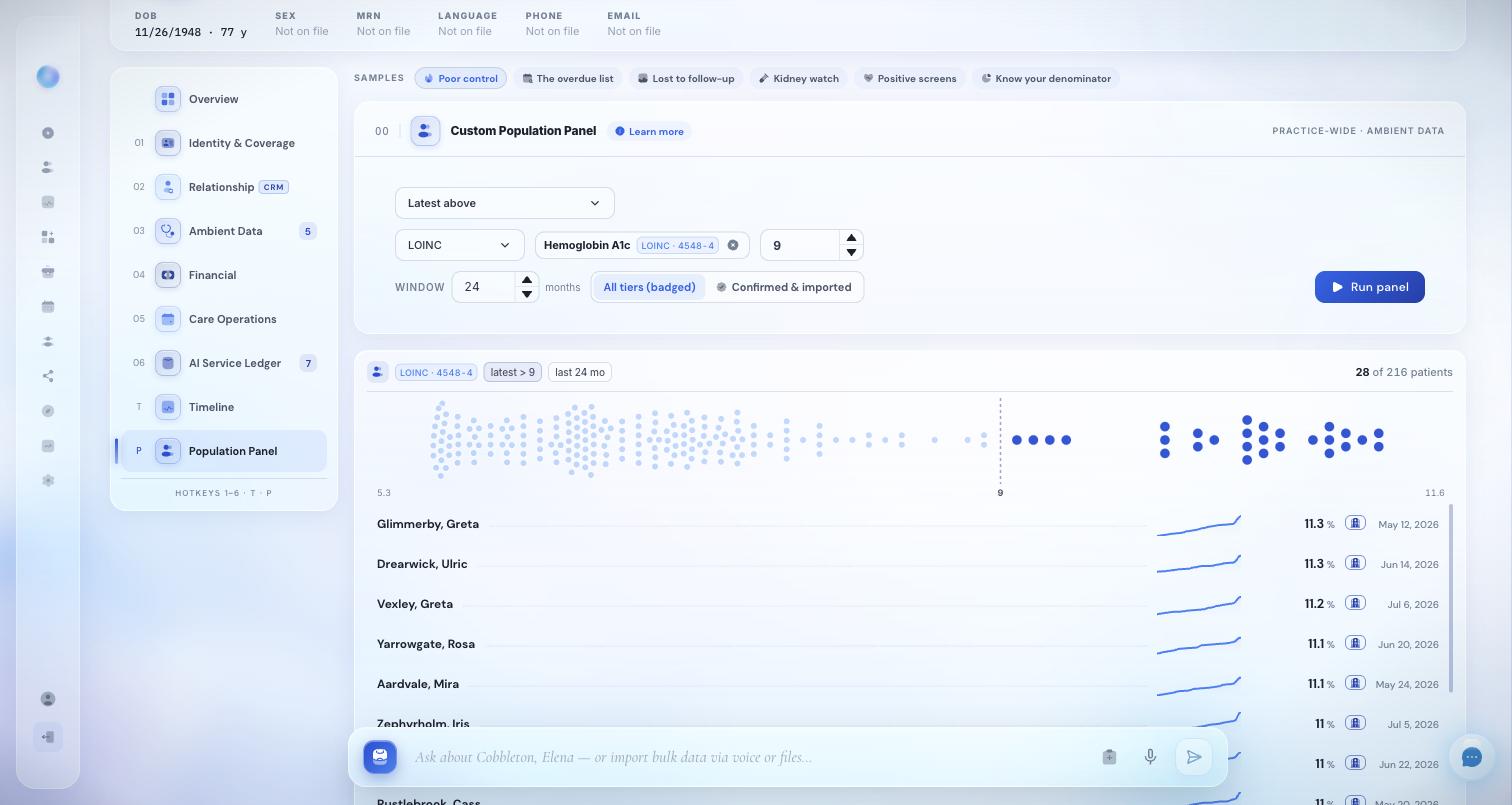
The Population Panel — one practice-wide query ("latest Hemoglobin A1c above 9, last 24 months") returning 28 of 216 patients, each with a trend sparkline and its evidence one click away.
Heidi's roadmap may reach some of this eventually. Today, its structured output ends at the encounter — and at $150/user/month, you are paying a premium for the note alone.
The AI Inbox Gap — Heidi Health Has Modules; DeepCura Has One Queue
Heidi Comms, launched in February 2026, handles patient calls, bookings, reminders, and follow-ups. It is a real product and a genuine expansion. But notice what it is: outbound patient communication. It is not an inbox. It does not give a front desk one place to stand and work through everything that arrived overnight.
That is the other half of a practice's day, and it is measured in queues: the fax tray, the shared email account, the missed calls nobody returned, the texts sitting unread. In July 2026 DeepCura shipped the AI Inbox — fax, email, phone, and SMS in a single work queue, with an AI agent that clears it on command. At the time of writing, Heidi's public documentation describes no inbound fax processing, no unified cross-channel queue, and no bulk disposition tooling.
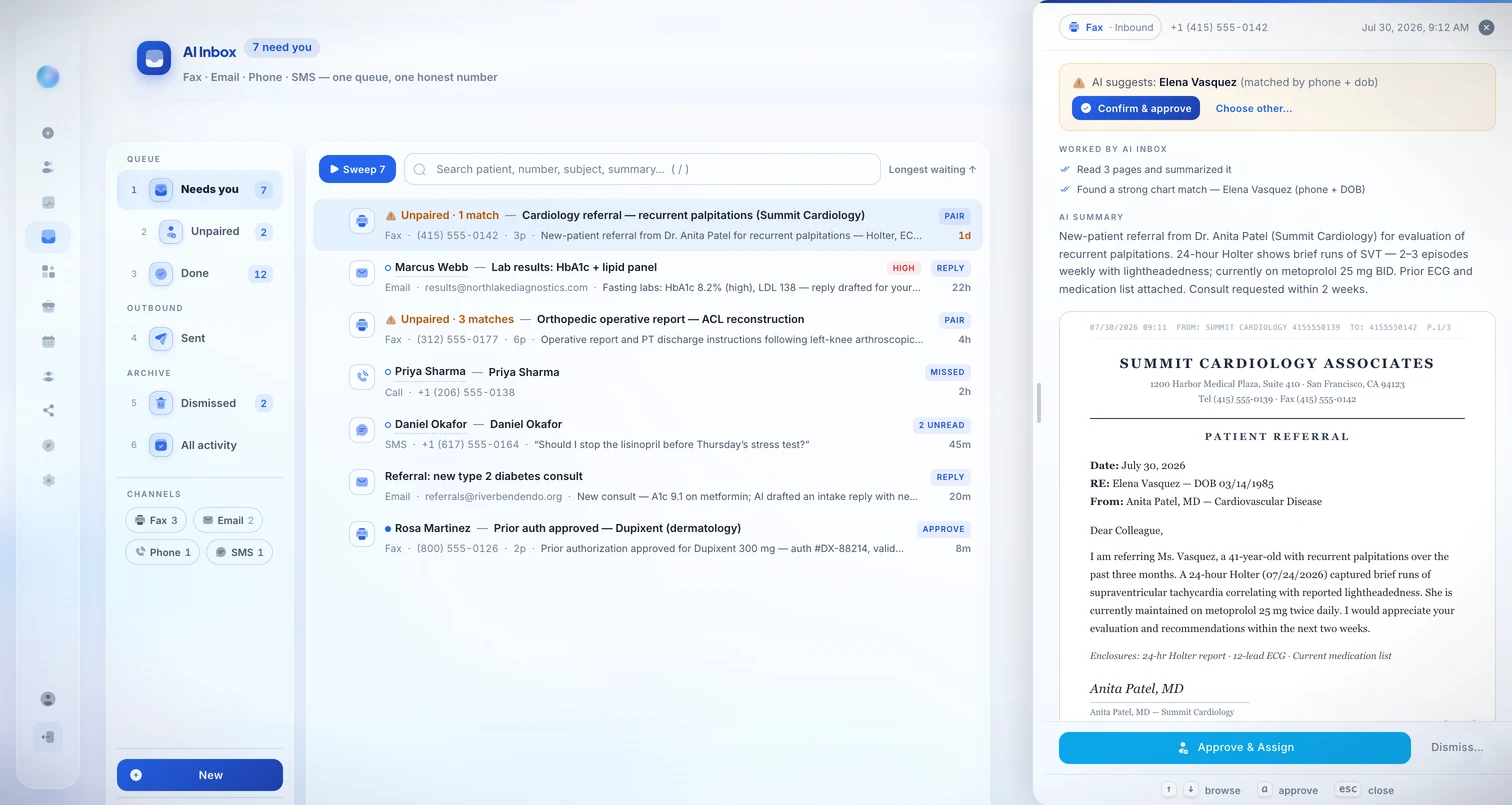
The AI Inbox — four channels, one queue, one honest count of what needs a human. The referral fax on the right arrived already read, summarized, and matched to Elena Vasquez by phone + DOB; "Worked by AI Inbox" shows exactly what the agent did before you got there.
Tell It "Zero My Inbox"
Press ⌘K from anywhere in the inbox and say it in plain language. The agent reads all four channels and returns one checklist of everything it proposes: the fax it would file and to which chart, the exact words it would text each missed caller, the emails it would draft — with the credit cost totalled before you commit. Uncheck any row. Nothing runs until you confirm.
The gate is enforced on the server, not implied by the interface:
- The confirm is real. The execution step refuses outright unless the proposal carries a confirmation flag that only your browser can set — the model cannot forge it, and it cannot stage and execute inside a single turn.
- A double-click can't send a second text. The batch is claimed with a single-shot lock before the first side effect, so a duplicate confirm returns "already executed" rather than a second message to a patient.
- Unchecking is binding. Your skipped rows are stored server-side and merged with whatever the model relays back. The agent can skip more than you asked; it can never skip fewer.
- Proposals expire. Walk away and the staged batch dies in 30 minutes instead of waiting to be confirmed by accident.
The Refusals Are the Product
What an automation declines to do in bulk matters more than what it will:
- Weak patient matches never auto-file. A fax pairs itself only on a strong match — MRN, phone + date of birth, name + date of birth, or a human's manual pick. Phone-only or name-only is a weak match and stays a human decision, as do possible duplicates and faxes the AI could not read cleanly.
- The agent drafts email; it does not send it. Replies land as drafts in your own inbox. Sending was deliberately withheld.
- Opt-outs are enforced at send time. If a patient has texted STOP, the message is refused downstream, reported honestly, and never retried.
These gates mirror the ones behind the manual buttons line for line, so the agent structurally cannot bulk-execute anything a human working one item at a time would be blocked from doing.
It Discloses What It Cannot See
The inbox counts pending faxes, missed calls, and unread texts. It does not count email, because email is a live merge with your Gmail rather than a number in a database — and instead of papering over that, the agent is instructed to say so. It claims "all caught up" only when the counts it can actually see are zero, and it names email as the thing it cannot count. Consider how rare that is in a category built on confident-sounding summaries.
Every Action Leaves a Receipt
Each executed item writes a real entry on the patient's timeline attributed as "AI Inbox on behalf of Dr. ___" — the fax pairing, the text, the archived call, the drafted email — alongside a summary of the whole batch: attempted, executed, failed, skipped by you, blocked by guardrails, and what it cost. If the agent says it did something, there is a durable record proving it.
Pricing matches what a human clicking the same buttons pays: 1 credit per text, 1 per AI-drafted email reply, and free for filing a fax, dismissing a fax, marking a call handled, or tagging one. No batch surcharge for letting the AI do it — and the preview states the total before you confirm. Heidi charges $150/user/month for a product that never enters this workflow at all.
Everything Feeds One Context — Modules Versus a Shared Brain
This is the structural difference behind every line item above, and it is worth stating plainly: DeepCura's AI Inbox is not a separate product with its own database. It is the same agent, the same patient records, and the same timeline as the scribe, the receptionist, and the billing engine.
While it works your inbox, that agent can also:
- Pull one patient's entire communication history across all four channels at once — every text, email, call, and fax for that person as a single view, instead of four searches in four systems.
- Read the coded patient brief the ambient scribe built — problems, meds, trends captured from visit conversation — so a drafted reply comes from something that knows the clinical picture, not just the last message.
- Query the whole panel mid-triage using the same cohort engine behind the Population Panel: "which of these callers is overdue for an A1c?" is a question you can ask while clearing the queue.
- Ask the scheduling agent about real availability before proposing a time to text a patient.
Now compare that with a module architecture. Heidi Comms handles calls. Heidi Evidence answers clinical questions. The scribe writes notes. AI coding suggests codes. Each is competent, and each produces its own output — which is exactly the sentence in this review's comparison table. The human is left as the integration layer, carrying context between products by retyping and remembering.
DeepCura's agents are not separate products sold together. They are roles working inside one context: the receptionist's call becomes an inbox item, the inbox files the fax into the chart, the fax's contents become coded chart entries, those entries become the trend and the population panel, and the panel tells the inbox agent who to text next. Say something once, and every agent knows it. No amount of module-shipping produces that, because it is a property of how the data is stored — not of any individual screen. And DeepCura delivers it for $21/month less per provider than Heidi charges for the scribe.
The Agentic Chat Gap — One Query, Many Actions
Heidi's chat is a single-turn input. You ask one question, you get one answer. Look at the box at the bottom of every Heidi note — a placeholder that simply reads "Ask Heidi to do anything…" That is where the agentic story ends.
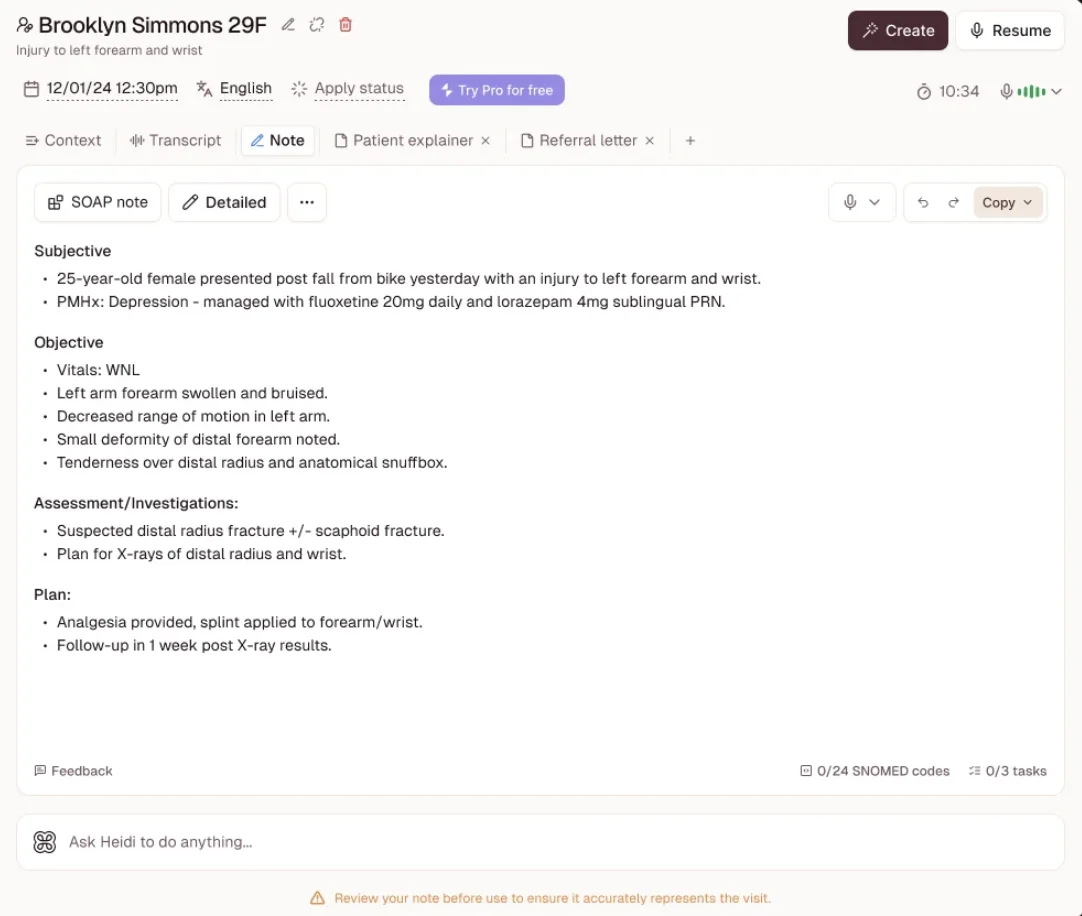
Heidi's chat input — one question, one answer. No way to chain template retrieval, patient history lookup, and note generation into a single instruction. Screenshot extracted from Heidi's official G2 profile.
DeepCura's Agentic Chat is fundamentally different. It is not a chat box — it is an LLM-driven orchestrator (Claude, GPT, or Gemini) that can chain multiple backend actions inside a single user prompt. When you ask DeepCura to "pull this patient's last visit, apply my Cardiology Follow-Up template, and add F48.9 to the problem list," the agent autonomously fires three separate tool calls behind the scenes — fetching the prior chart, locating your saved template, loading its structure — then merges everything into one finished note. No clicking. No copying, splitting, or opening unnecessary tabs. No second prompt.
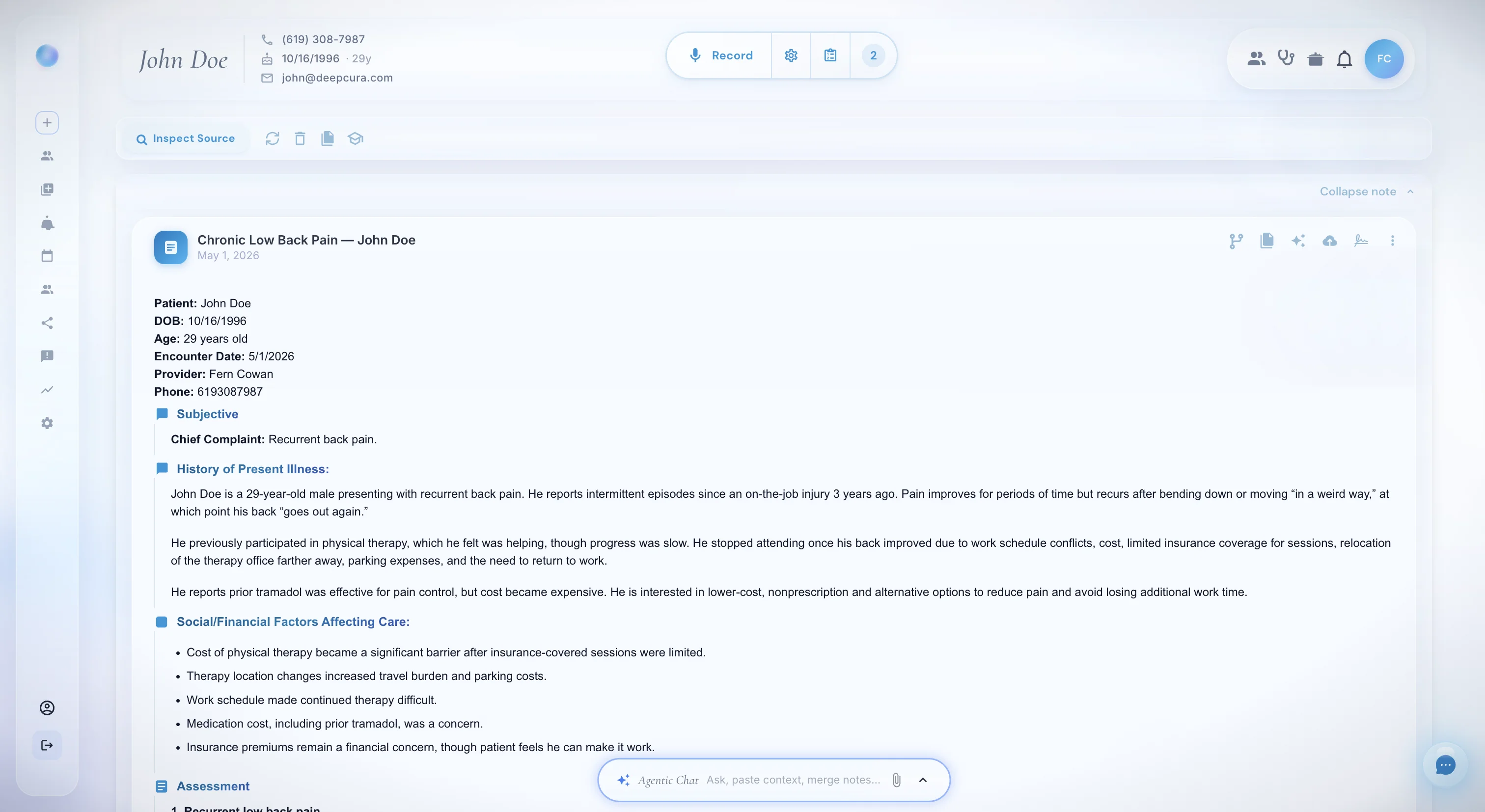
DeepCura's Agentic Chat sits inside every patient chart — type one instruction and the AI chains template retrieval, patient history lookup, ICD-10 coding, and note generation in a single pass.
Three real prompts a clinician can fire today, each chaining two or three backend actions in one query:
- "Pull the last visit, add F48.9 as a new diagnosis, and reformat with my SOAP template." → agent chains fetch recent transcript → list templates → load SOAP template → emits the rewritten note.
- "Apply my Cardiology Follow-Up template to today's encounter and write a referral letter to Dr. Martinez." → list templates → load Cardiology template → generate note → generate referral letter in sequence.
- "Change the metformin dose to 1000 mg in the most recent note and update the plan section." → fetch recent transcript → edit the targeted field → re-emit the full note with no other changes.
This is what agentic actually means in clinical software: the model decides which backend function to call, in what order, and how to combine the results — all from one natural-language sentence. Heidi's chat can answer questions about a single note. DeepCura's Agentic Chat orchestrates the entire encounter — and every tool call is audited inside the saved transcript so you can see exactly what context the agent pulled.
And DeepCura is $21/month cheaper than Heidi's Clinician plan ($129 vs $150, both month-to-month) — while including a full roster of extra AI agents beyond the scribe.
September 2026 Update
Two facts changed since the March update below. Heidi's Trustpilot score has slipped to 3.1 out of 5 across 503 reviews (accessed September 19, 2026; the most recent reviews are dated September 2026), down from 3.3 across 481 in May — the recent feed is still dominated by one-star reports about lost recordings and support. And Heidi's public pricing page now shows Free, Clinician (14-day trial) and sales-led team tiers. Re-checked on September 27, 2026 for US visitors, the Clinician plan is $150 per user per month on monthly billing, with a lower per-month rate when billed annually — an earlier version of this review described $150 as the annual-billing rate, which we have corrected. The pricing table and the FAQ below reflect both.
March 2026 Update
Since our initial review, Heidi Health has made significant strides in expanding beyond ambient documentation into a broader clinical AI platform. In February 2026, Heidi launched two major new products: Heidi Evidence — an ad-free, citation-backed clinical decision support tool built in partnership with HealthPathways, BMJ Group, NICE, and others — and Heidi Comms — an AI-powered patient communications tool that handles calls, bookings, reminders, and follow-ups across channels. Heidi also acquired UK-based clinical AI company AutoMedica as part of this expansion.
On the EHR front, Heidi now offers push-to-chart integrations with athenahealth (via the Athena Marketplace, with section-based note linking), Epic (with SmartSections mapping), and eClinicalWorks (via Vim's integration platform). These are available on the Together plan and above. Heidi has also partnered with R1 RCM to integrate real-time billing guidance, payer intelligence, and prior authorization information at the point of care.
Pricing has changed again: the main paid plan is now called Clinician at $150/user/month on monthly billing (less when billed annually). This is a significant increase from the $99/month Pro plan we previously reported. Language support has expanded dramatically to 110+ languages across 116 countries.
Multi-language support remains Heidi Health's strongest differentiator — particularly for US-based practices serving multilingual patient populations. But the pricing change is hard to ignore. At $150/user/month, Heidi now costs more than DeepCura ($129/month) — which includes dedicated AI agents for every channel, the AI Inbox (fax, email, phone, and SMS in one queue an agent clears on command), Ambient Data (spoken values become coded, evidence-linked chart entries), an AI receptionist you can test without a sales call, real-time SMS during AI calls, and native bidirectional API integrations across athenahealth, AdvancedMD, and five other EHR systems. The competitive landscape has shifted: Heidi is no longer just less capable — it is now more expensive too.
What Is Heidi Health?
Heidi Health is an AI-powered clinical documentation platform that uses ambient listening to capture patient encounters and generate structured clinical notes. The platform was originally built for the Australian healthcare market, where it gained traction among general practitioners and specialists looking to reduce documentation burden without overhauling their existing workflows.
Since its launch in Australia, Heidi Health has expanded to serve clinicians in the United States and United Kingdom. The platform supports localized clinical terminology and note formats tailored to each market — accommodating Australian Medicare documentation requirements, UK NHS standards, and US clinical note conventions from a single product. This multi-market approach is a genuine differentiator in a space dominated by US-centric tools.
Heidi Health has evolved beyond a documentation-only tool. While ambient scribing remains its core, the platform now includes Heidi Evidence (clinical decision support), Heidi Comms (AI-powered patient communications), EHR push-to-chart integrations, and AI-assisted coding. At the time of writing, Heidi's public documentation does not mention AI fax management or automated patient intake as standalone features. On Trustpilot, Heidi Health holds a 3.1 out of 5 rating across 503 reviews (accessed September 19, 2026). Understanding the current scope is important for evaluating whether Heidi Health fits your practice's needs.
How Heidi Health Works
The core workflow in Heidi Health follows the same ambient scribing pattern used by most modern AI documentation tools, but with some notable flexibility in how clinicians configure their output.
During a patient encounter, the clinician activates Heidi Health's ambient listening mode. The platform captures the conversation between clinician and patient in real time, processing the audio through its AI engine to identify clinical content, separate speakers, and extract relevant medical information. No special hardware is required — Heidi Health works through a standard laptop or tablet microphone.
Once the encounter is complete, Heidi Health generates a structured clinical note based on the conversation. The note format is determined by the clinician's template configuration — SOAP notes, progress notes, specialist referral formats, and custom structures are all supported. Clinicians can define which fields appear in their notes, how information is organized, and what level of detail the AI should include for each section.
The template customization system is one of Heidi Health's standout features. Rather than offering a handful of preset note formats, the platform allows clinicians to build templates that match their exact documentation preferences. Fields can be added, removed, or reordered. Section headings can be customized. The depth of documentation per section can be configured — a useful feature for specialists who need detailed findings in certain areas and brief summaries in others.
After reviewing and making any necessary edits, the clinician copies the completed note into their EHR. Heidi Health supports standard EHR integrations, though the depth of these integrations varies — more on that in the limitations section below.
Heidi Health Pricing
Heidi Health has restructured its pricing significantly in 2026:
- Free — $0/month. Unlimited basic consults and dictation, with 10 "Pro Actions" per month (Ask Heidi prompts, template customization).
- Clinician — $150/user/month on monthly billing, less when billed annually (see the table below). The main paid plan — includes unlimited Pro Actions, custom templates, unlimited AI documents, and priority support. At the month-to-month rate it is one of the most expensive AI scribes on the market for US practices.
- Enterprise — Custom pricing. Includes SSO, coding workflows, multi-team management, EHR push-to-chart integrations, and organization-wide BAA.
| Tool | Plans | Monthly | Included / limits | Verified |
|---|---|---|---|---|
| Heidi Health | Free · Clinician | Free · $150 ($110 billed annually) | unlimited transcription + standard templates; advanced features gated · per user; 14-day free trial; custom templates | 2026-09-27 |
| DeepCura | All AI agents, per provider | $129 ($83.25 billed annually) | 1,000 credits/mo; 1 credit per standard note; +$59/mo add-on raises it to 2,000; seat tiers from $101 | 2026-08-17 |
| Freed AI | Starter · Core · Premier | $39 · $79 · $119 ($104 billed annually) | 40 notes/mo · unlimited notes · EHR push + ICD-10/CPT; 7-day trial | 2026-09-27 |
Vendor prices verified on the dates shown (earliest 2026-08-17); vendors change plans — confirm with each vendor before buying. DeepCura row: current plan; competitor rows: publicly published prices.
See pricing →$129/mo per provider · 1,000 credits/mo · 1 credit per standard note
At $150/user/month, Heidi Health is no longer competitively priced among AI scribes. It now costs $21 more per month than DeepCura — which includes dedicated AI agents (Agentic Scribe, Receptionist, Nurse, AI Inbox, Marketing, Billing, Fax, Payments, Prior Auth), the AI Inbox that clears fax, email, phone, and SMS from one queue, real-time SMS during AI calls, native bidirectional EHR write-back (athenahealth, eClinicalWorks, AdvancedMD, OptiMantra, Epic, DrChrono, CharmHealth, and Cerner) on all plans, and the ability to test the AI receptionist without booking a sales call — all for $129/month. For a 5-provider clinic, Heidi costs $750/month vs. DeepCura's $606/month (seats 1–2 at $129, seats 3–5 at $116) — a $144/month difference while getting fewer features.
Heidi Health offers a free tier to test basic features, but you cannot test Heidi Comms (AI calls) without booking a sales demo — a significant barrier for practices that want to evaluate before committing.
Here is how the Heidi AI scribe's pricing compares against a full-platform alternative:
| Plan | Price | AI Agents | EHR Write-Back | Key Limitation |
|---|---|---|---|---|
| Heidi Clinician | $150/user/mo month-to-month | 1 (scribe only) | ✗ (requires Enterprise) | No EHR push; no fax; lower rate only if billed annually |
| Heidi Enterprise | Custom pricing | 1-2 modules | Push-to-chart (select EHRs) | Custom pricing; no SMS during calls |
| DeepCura | $69/mo with HEIDI50 (first 6 months, then $129) | Dedicated agents — scribe, receptionist, nurse, inbox, marketing, billing, fax, payments, prior auth | Native bidirectional API (athenahealth, eCW, AdvancedMD, OptiMantra, Epic, DrChrono, CharmHealth, Cerner) | — All agents + Ambient Data included |
At $150/user/month, the Heidi AI scribe is now one of the most expensive ambient documentation tools on the market — and the value equation no longer works in its favor. For $21 less per month, DeepCura gives you dedicated AI agents — Agentic Scribe, AI Receptionist, AI Nurse, AI Inbox, AI Marketing, AI Billing, AI Fax, AI Payment Collection, and AI Prior Authorization — all included, all active, all orchestrating across every communication channel your practice uses, all reading and writing one shared patient context. You also get Ambient Data — every value spoken in the visit becomes a coded, evidence-linked chart entry you approve — plus native bidirectional EHR write-back for athenahealth, eClinicalWorks, AdvancedMD, OptiMantra, Epic, DrChrono, CharmHealth, and Cerner (included on all plans, not gated behind an enterprise tier), the ability to choose your AI engine (GPT, Claude, or Gemini), and an AI receptionist you can test yourself without booking a sales call — one that can chat with patients via SMS during a live call to confirm details with 100% accuracy. You pay less and get dramatically more. That is not a trade-off — that is Heidi pricing itself out of the market.
Heidi AI Scribe: Key Features
Ambient Encounter Capture
Heidi Health captures clinical conversations in real time using ambient listening. The platform processes audio through its AI engine, identifying speakers, extracting clinical content, and organizing information for note generation. The capture works across in-person visits and can also handle telehealth encounters.
SOAP and Custom Note Generation
The platform generates structured clinical notes in standard formats including SOAP, progress notes, and specialty-specific templates. Note generation is fast, typically delivering a complete draft within seconds of the encounter ending. The AI handles standard clinical terminology well and organizes content according to the clinician's template configuration.
Multi-Language Support
Heidi Health supports clinical encounters conducted in over 110 languages — a dramatic expansion from earlier versions that supported around 12 languages. This is a meaningful capability for practices serving multilingual patient populations. The platform can process conversations in multiple languages and generate clinical notes that reflect the encounter accurately. For clinics where patients frequently speak languages other than English, this feature alone may justify evaluating Heidi Health over competitors that only support English-language encounters.
Region-Specific Note Formats
The platform offers note formats tailored to Australian, UK, and US healthcare documentation standards. Australian clinicians get formats aligned with Medicare and GP documentation norms. UK users receive formats consistent with NHS documentation practices. US clinicians get standard American clinical note structures. This localization goes beyond simple formatting — it extends to clinical terminology and documentation conventions specific to each market.
Custom Note Templates
Heidi Health's template customization system allows clinicians to define their note structure with considerable granularity. Templates can be built from scratch or modified from existing presets. Clinicians control which sections appear, how they are ordered, what level of detail the AI provides per section, and how information is formatted. For practices with specific documentation requirements — whether driven by specialty conventions, compliance needs, or personal preference — this flexibility is valuable. For free, copy-paste-ready templates you can use today, see our Doctor's Note Template collection.
HIPAA Compliance and BAA
Heidi Health is HIPAA compliant and provides a Business Associate Agreement (BAA) for US-based practices. The platform holds ISO 27001 and SOC 2 Type II certifications, and encrypts data in transit and at rest. Heidi does not store audio recordings after transcription. For Australian and UK users, the platform complies with applicable local data protection regulations including GDPR, PIPEDA, and the Australian Privacy Principles (APPs).
What the Heidi AI Scribe Does Well
Multi-language clinical documentation is a genuine differentiator. In a market where most AI scribes are built exclusively for English-language encounters, Heidi Health's ability to handle multilingual clinical conversations is a real advantage. Practices serving diverse patient populations can document encounters accurately regardless of the language spoken during the visit. This capability is not a marketing afterthought — it is built into the core product.
The template customization system is excellent. Heidi Health gives clinicians meaningful control over how their notes are structured and formatted. The depth of customization goes beyond what most competitors offer, allowing clinicians to build templates that genuinely match their documentation workflow rather than adapting to rigid preset formats.
Note accuracy is strong across specialties. In routine clinical encounters, Heidi Health produces notes that require minimal editing. The AI handles standard medical terminology competently and organizes clinical content in a logical structure. For straightforward patient visits, the generated notes are ready to use with minor review.
The interface is clean and intuitive. Heidi Health avoids interface clutter. The user experience is straightforward — start a visit, capture the encounter, review the note, and export. There is no steep learning curve, and clinicians can begin using the platform productively within their first session.
A free tier exists for basic testing. Heidi Health offers a free plan with unlimited basic notes and 10 Pro Actions per month, which is useful for initial evaluation. However, the paid Clinician plan at $150/user/month month-to-month — less only if you commit to annual billing — is no longer competitively priced. Full-platform alternatives like DeepCura include a full roster of AI agents, a unified AI Inbox, and EHR write-back for $129/month.
Active product development keeps the platform current. Heidi Health ships updates frequently, expanding its feature set and improving its AI models. The development team appears responsive to clinician feedback, and the product has improved meaningfully over the past year.
International and multi-market practices benefit most. For clinicians who operate across Australian, UK, and US markets — or who serve patient populations that span multiple languages — Heidi Health addresses a gap that most US-centric competitors ignore entirely.
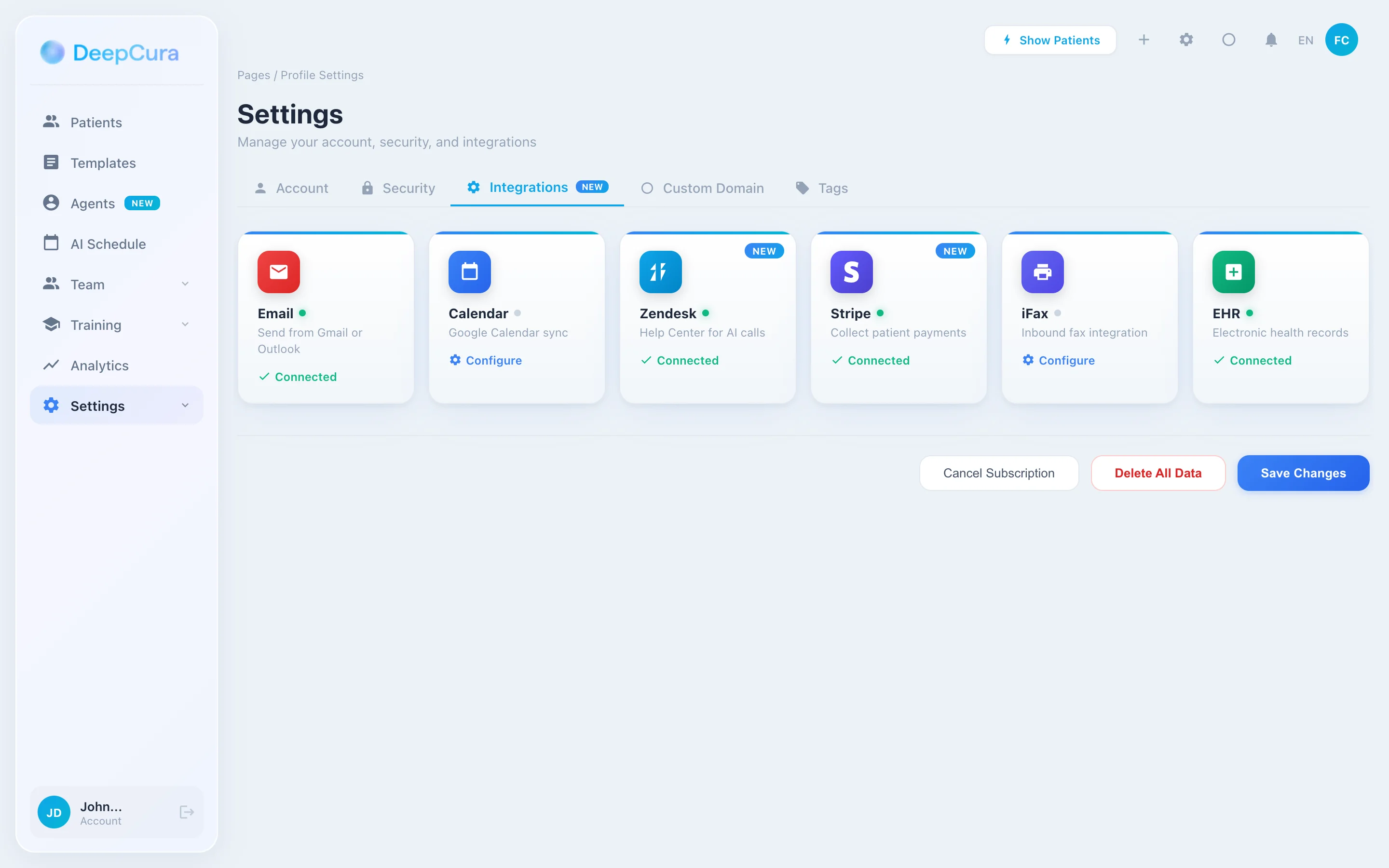
DeepCura's integration settings — Email, Calendar, Zendesk, Stripe, iFax, and EHR all connected from a single dashboard. This is DeepCura's UI, not Heidi Health's.
Heidi AI Scribe Accuracy by Specialty
The Heidi AI scribe performs well across standard clinical encounters, with particular strength in multilingual documentation where competitors struggle. Here is how accuracy varies by specialty and context:
- Primary Care / Family Medicine: Standard office visits produce notes that are reliably accurate, requiring only minor editing. The AI captures chief complaints, HPI, ROS, and assessment and plan elements competently. Accuracy is comparable to other leading AI scribes in this setting.
- Internal Medicine: Complex multi-problem visits with extensive medication lists require more clinician review. Like most ambient scribes, the Heidi AI scribe handles individual problems well but can conflate or misequence elements when patients present with four or more active conditions.
- Psychiatry: Mental health documentation requires precise language for affect, risk assessment, and diagnostic criteria. The Heidi AI scribe captures the broad clinical narrative but psychiatrists should expect to edit notes for clinical nuance and safety documentation precision.
- Multilingual Encounters: This is where the Heidi AI scribe genuinely differentiates. With support for 110+ languages, clinical conversations conducted in non-English languages are processed with reasonable accuracy — a capability most competitors simply do not offer. Accuracy is strongest in widely spoken clinical languages and may vary for less common dialects or highly specialized terminology in other languages.
- Pediatrics: Well-child visits and developmental assessments are handled adequately. Three-way conversations between parent, clinician, and child present the same challenge as with other ambient scribes — speaker diarization is less reliable with more than two speakers.
- Surgical and Procedural Specialties: Anatomical terminology, surgical planning, and procedure-specific documentation challenge the Heidi AI scribe similarly to other generalist ambient tools. Standard evaluations are handled well; complex operative planning requires significant editing.
For any specialty, testing the Heidi AI scribe with your 10 most common encounter types during the free trial is the best way to evaluate real-world accuracy before committing.
Where Heidi Health Falls Short
Structured output is note-scoped — there is no ambient chart. Push-to-chart moves the finished note into EHR sections; AI coding suggests codes for that encounter. Neither turns what was said into longitudinal, coded chart data with evidence attached, and there is no population layer to query across patients. DeepCura's Ambient Data stages coded, audio-anchored chart entries you approve — which become trends, custom trackables, and practice-wide care-gap lists.
Heidi Comms is new and unproven in the US market. In February 2026, Heidi launched Heidi Comms — an AI-powered patient communications tool that handles calls, bookings, reminders, and follow-ups. This is a significant addition, but the product is new and its depth of functionality in the US market remains to be seen. Established alternatives like DeepCura have offered a mature 24/7 AI receptionist as part of their standard offering for longer. For a full comparison, see our ranking of the best AI medical receptionists in 2026.
EHR integrations are gated behind the Enterprise plan. Heidi now offers push-to-chart integrations with athenahealth, Epic (via SmartSections), and eClinicalWorks (via Vim). However, these integrations require the Enterprise plan (custom pricing) — they are not available on the $150/month Clinician plan. The depth of these integrations also varies: athenahealth supports section-based note linking, while other EHR integrations may offer more limited functionality. Platforms like DeepCura include native bidirectional write-back for athenahealth, eClinicalWorks, AdvancedMD, OptiMantra, Epic, DrChrono, CharmHealth, and Cerner on all plans — for $129/month.
Coding is available but E&M integrity checks are limited. Heidi now offers AI-assisted coding with ICD-10 and SNOMED-CT code suggestions ranked by relevance. This is a meaningful improvement over earlier versions. However, the coding workflow is currently available on Enterprise plans, and the depth of E&M billing integrity checks — verifying that documentation supports the selected billing codes to prevent downcoding and audit risk — is less mature than dedicated billing AI tools.
At the time of writing, Heidi's public documentation does not mention AI fax management. For practices that still receive significant volumes of faxed referrals, lab results, and clinical correspondence, this means maintaining a separate workflow. DeepCura's fax agent summarizes every inbound fax, auto-matches it to the right patient (MRN first, then phone plus date of birth, then name — an ambiguous match is surfaced, never guessed), and after a one-click pairing stages the document's contents as evidence-linked chart suggestions for your review.
Clinical decision support is new via Heidi Evidence. In February 2026, Heidi launched Heidi Evidence — an ad-free clinical decision support tool built in partnership with HealthPathways, BMJ Group, NICE, EMGuidance, and others. This is a notable addition that addresses a previous gap. However, it is a newly launched product, and its depth compared to established clinical AI assistants remains to be evaluated. For practices that need AI-assisted clinical reasoning today, explore our guide to the best ChatGPT for doctors.
You cannot test Heidi Comms (AI calls) without booking a sales call. Want to hear what Heidi's AI phone agent sounds like before committing? You cannot. Heidi Comms requires you to book a demo with their sales team to evaluate the product. DeepCura's AI receptionist is fully self-service — you can test it live, hear the voice, run it through real scenarios, and evaluate its performance without ever talking to a salesperson. For practices that want to make technology decisions based on their own testing rather than a curated sales demo, this is a significant difference.
Heidi's AI calls cannot communicate with patients via SMS during a live call. This is a critical gap. When DeepCura's AI receptionist is on a call with a patient, it can simultaneously send an SMS to the patient to confirm details — spelling of names, insurance ID numbers, medication lists, appointment preferences — ensuring 100% accuracy on information that ambient audio alone frequently garbles. Heidi Comms has no equivalent capability. The result is that Heidi's AI calls rely entirely on voice-to-text accuracy for capturing patient details, while DeepCura's dual-channel approach (voice + SMS) eliminates the transcription errors that plague every voice-only system.
No choice of AI engine. Clinicians cannot select which underlying AI model generates their notes. Some platforms allow clinicians to choose between models like GPT, Claude, or Gemini based on which performs best for their specialty. At the time of writing, Heidi Health does not offer this flexibility.
At the time of writing, Heidi's public documentation does not mention pre-visit patient intake automation. Heidi Health does not appear to handle pre-visit patient intake, medical history collection, or pre-visit summaries as standalone features. The platform's core involvement begins when the clinical encounter starts. For practices that need to streamline the intake process, see our guide to patient intake form templates with free downloads for 8 specialties.
No unified inbox — and nothing that clears one. Heidi Comms handles outbound patient communication: calls, bookings, reminders, follow-ups. It is not an inbox. At the time of writing, Heidi's public documentation describes no inbound fax processing, no cross-channel work queue, and no bulk disposition tooling — so the fax tray, the shared email account, the missed-call list, and unread texts remain four separate places your staff has to stand. DeepCura's AI Inbox collapses all four into one queue and puts an agent on top of it: say "zero my inbox" and it returns a single checklist of every action it proposes — the fax it would file to a named chart, the exact words it would text each missed caller, the emails it would draft — priced before you commit, behind a server-enforced confirm gate, with guardrails that refuse to batch weak patient matches or possible duplicates, TCPA opt-out enforcement at send time, and a timeline entry for every executed item.
Heidi is expanding, but modules are not the same as agents on one context. DeepCura deploys 9 separate AI agents — Agentic Scribe, AI Receptionist, AI Nurse, AI Inbox, AI Marketing, AI Billing, AI Fax, AI Payment Collection, and AI Prior Authorization — orchestrating across voice calls, SMS, fax, email, EHR systems, payment processors, and payer portals simultaneously. Heidi Health is adding capabilities (Heidi Comms, Heidi Evidence, coding), but these are modules within a single product, each producing its own output. The distinction is not marketing arithmetic: DeepCura's agents read and write a single shared patient timeline, so the inbox agent drafting a reply can already see what the scribe heard in the room last week and what the schedule looks like next Tuesday. When your front desk handles 50+ calls, 30+ faxes, and dozens of billing tasks a day, the expensive part is not any one task — it is the human carrying context between four systems that do not talk.
Growing but still smaller US user base compared to domestic competitors. As an Australian-origin platform, Heidi Health has a smaller institutional footprint in the US compared to established domestic alternatives, though its recent $65M Series B funding and R1 RCM partnership signal accelerating US market investment.
Who Is Heidi Health Best For?
Heidi Health is a strong fit for several specific practice profiles:
International and multi-market practices. If your organization operates clinics in Australia, the UK, and the US — or if you see patients across borders — Heidi Health's localized note formats and multi-market support address a genuine gap that most competitors do not fill.
Clinicians who see patients in multiple languages. Practices serving multilingual patient populations benefit directly from Heidi Health's multi-language documentation capabilities. If a significant portion of your encounters occur in languages other than English, this feature is a meaningful differentiator.
Practices that prioritize template customization. If you have specific documentation requirements driven by specialty conventions, compliance needs, or personal workflow preferences, Heidi Health's deep template customization system gives you the control you need.
Clinicians whose primary need is multilingual documentation — and who are willing to pay a premium for it. At $150/user/month month-to-month (less when billed annually), Heidi Health is no longer the budget-friendly option it once was. The free tier is useful for testing, but the paid plan now costs more than full-platform alternatives. For clinicians whose only priority is multilingual ambient scribing and who do not need EHR write-back, an AI receptionist, billing, or fax, Heidi remains a focused choice — just no longer a value-priced one.
Who Should Consider Alternatives?
Heidi Health is not the right fit for every practice. Consider looking elsewhere if your needs extend beyond ambient documentation:
US practices needing deep, bidirectional EHR integration without paying enterprise pricing. Heidi now offers push-to-chart integrations with select EHR systems, but these require the Enterprise plan (custom pricing) — they are not available on the $150/month Clinician plan. If deep, included-on-every-plan EHR write-back with Epic, eClinicalWorks, Athena, AdvancedMD, and others is critical to your workflow, DeepCura includes it on all plans for $129/month.
Clinics that want a mature AI receptionist they can test themselves. Heidi Comms launched in February 2026 and requires booking a sales demo to evaluate. If you want to test an AI receptionist on your own terms — hear the voice, run real patient scenarios, see how it handles edge cases — DeepCura's self-service approach lets you do that today. DeepCura's AI receptionist also sends SMS messages to patients during live calls to confirm names, insurance IDs, and appointment details, eliminating the transcription errors that voice-only systems can not avoid.
Practices that need AI agents covering every communication channel — for less money. If your practice handles high volumes of calls, faxes, billing tasks, prior authorizations, and payment follow-ups, you need a platform with dedicated agents for each channel — and one queue where all of it lands. DeepCura's AI agents (Agentic Scribe, Receptionist, Nurse, AI Inbox, Marketing, Billing, Fax, Payments, Prior Authorization) orchestrate across voice, SMS, fax, email, EHR, payment processor, and payer portal simultaneously, all reading and writing one shared patient context — for $129/month, which is $21/month less than Heidi's Clinician plan that only includes the scribe. Heidi is expanding but does not yet cover these workflows, and has no unified inbox at all.
Front desks drowning in four separate queues. A fax tray, a shared email account, a missed-call list, and unread texts is four places to stand and four contexts to hold. DeepCura's AI Inbox makes it one queue with an AI that proposes every disposition at once for a single confirm. Heidi Comms sends messages out; it does not give you a queue to clear.
Practices that want the visit itself to update the chart. Heidi's structured output ends at the note. If you want spoken diagnoses, med changes, and values to become coded, evidence-linked chart entries — with trends, custom trackables, and population-level care-gap lists built on top — that is DeepCura's Ambient Data, and Heidi has no equivalent today.
For $129/month — $21 less than Heidi Health's $150/month Clinician plan — DeepCura includes dedicated AI agents for every channel, the AI Inbox (fax, email, phone, and SMS in one queue an agent clears on command, with every proposed action priced and approved before it runs), Ambient Data (spoken values become coded, evidence-linked chart entries you approve, with population panels and care-gap lists on top), inbound faxes that auto-pair to the right patient and stage chart updates, native bidirectional EHR write-back on every plan, real-time SMS during AI calls, and fully self-service testing (no sales call required). Less money. More agents. One shared context. A chart that fills itself and an inbox that clears itself.
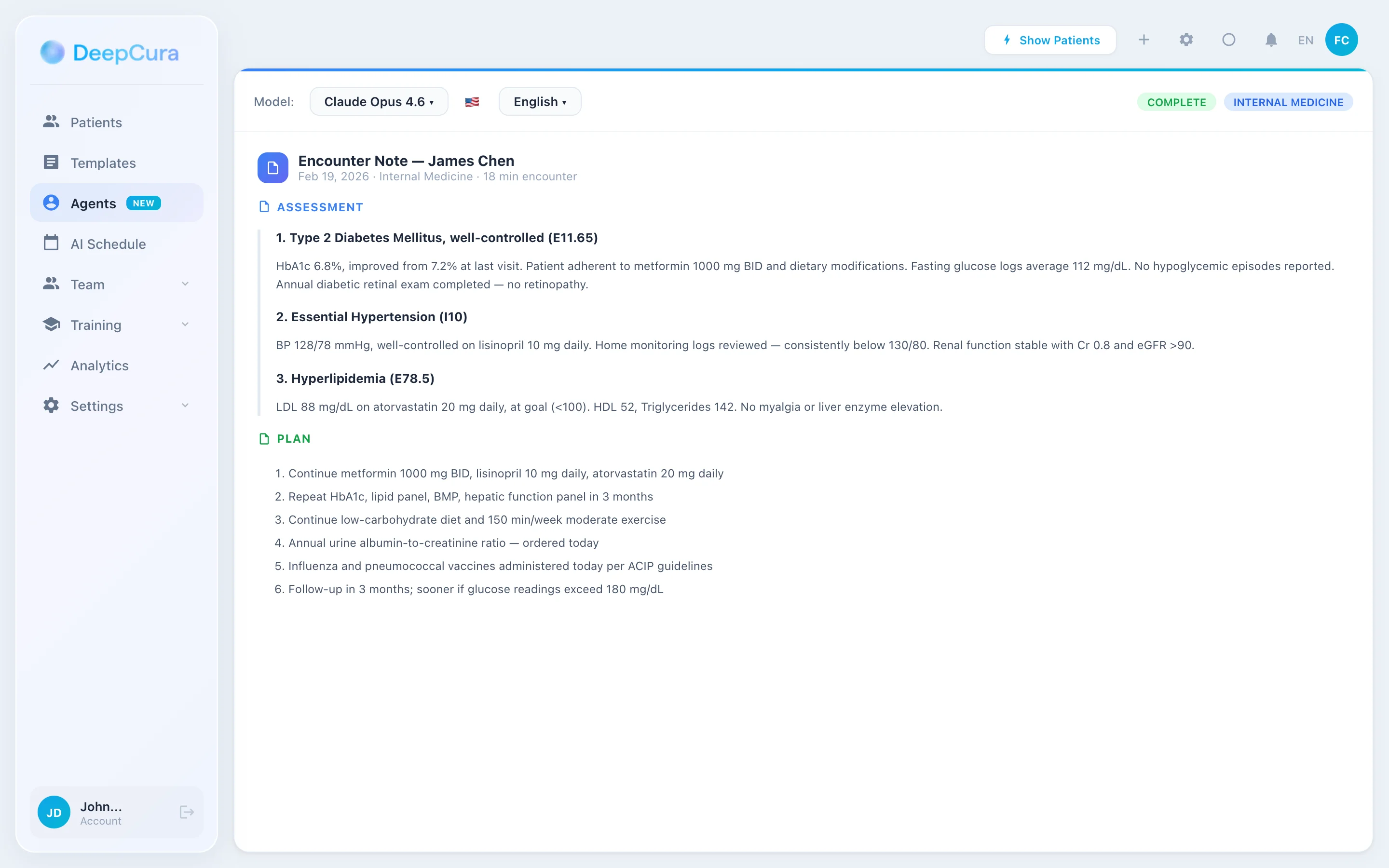
DeepCura's AI scribe interface — choose between Claude, GPT-4o, or Gemini for note generation. This is DeepCura's UI, not Heidi Health's.
Heidi AI Scribe vs Full-Platform Solutions
The Heidi AI scribe's core strength is ambient documentation during the encounter, though the platform has expanded into pre-visit communications (Heidi Comms), clinical decision support (Heidi Evidence), coding, and EHR push-to-chart. To evaluate whether the current scope is enough for your practice, here is how Heidi Health compares across every phase — before, during, and after the visit.
Pre-Visit Automation
| Feature | Heidi Health | DeepCura |
|---|---|---|
| AI Patient Intake | ✗ | ✓ |
| AI Receptionist (Phone) | ✓ (Heidi Comms — new) | ✓ |
| Test AI Receptionist Without Sales Call | ✗ (must book demo) | ✓ (fully self-service) |
| Real-Time SMS During AI Calls | ✗ | ✓ (confirms details via text while on call) |
| Pre-Visit Summary | ✗ | ✓ |
Heidi Comms, launched in February 2026, now handles patient calls, bookings, reminders, and follow-ups — a significant addition. However, there are two critical differences. First, you cannot test Heidi Comms without booking a sales demo — DeepCura's AI receptionist is fully self-service, so you can hear it, test it, and evaluate it on your own terms. Second, DeepCura's AI receptionist can send an SMS to the patient during the live call to confirm spellings, insurance IDs, and appointment details — ensuring 100% accuracy on information that voice-only systems routinely garble. Heidi Comms has no equivalent dual-channel capability. At the time of writing, Heidi also does not appear to offer automated patient intake forms or pre-visit summary generation. DeepCura's AI receptionist answers patient calls 24/7, handles scheduling and triage, confirms details via SMS mid-call, and generates pre-visit summaries so the clinician walks into every encounter already informed.
During the Visit
| Feature | Heidi Health | DeepCura |
|---|---|---|
| AI Medical Scribe | ✓ | ✓ |
| Custom Note Templates | ✓ | ✓ |
| 50+ Specialties | ✓ | ✓ |
| Multi-Language Support | ✓ (110+ languages) | ✓ |
| Clinical AI Chat (Copilot) | ✓ (Heidi Evidence — new) | ✓ |
This is where the Heidi AI scribe delivers its core value — and where its multilingual capability shines. Both platforms offer ambient scribing across 50+ specialties, but Heidi Health's multi-language documentation across 110+ languages is a genuine differentiator for practices serving multilingual patient populations. Heidi Evidence, launched in February 2026, now provides evidence-based clinical decision support with citations from trusted sources like BMJ, NICE, and HealthPathways. DeepCura includes a clinical AI copilot for real-time clinical reasoning — differential diagnosis support, drug interaction checks, and evidence-based recommendations.
Post-Visit Automation
| Feature | Heidi Health | DeepCura |
|---|---|---|
| AI Billing / Coding | ✓ (ICD-10, SNOMED-CT — Enterprise) | ✓ (E&M integrity checks) |
| Coded Chart Updates from the Visit (Review-Gated) | ✗ (coding is note-scoped) | ✓ (evidence-linked) |
| Population Panels & Care-Gap Lists | ✗ | ✓ |
| EHR Integration (Push-to-Chart) | ✓ (Together plan; athena, Epic, eCW) | ✓ (Native bidirectional API — athenahealth, eCW, AdvancedMD, OptiMantra, Epic, DrChrono, CharmHealth, Cerner — all plans) |
| AI Prior Authorization | ✓ (via R1 RCM partnership — new) | ✓ |
| AI Referral Letters | ✓ | ✓ |
| AI Tasks & Alerts | ✗ | ✓ |
| AI Fax Management (Auto-Pair + Chart Suggestions) | ✗ | ✓ |
| AI Inbox (Fax + Email + Phone + SMS in One Queue) | ✗ | ✓ |
| Bulk Dispositions with Preview → Confirm → Execute | ✗ | ✓ |
| AI Payment Collection (Stripe) | ✗ | ✓ |
Post-visit is where the gap between the Heidi AI scribe and a full clinical AI platform has narrowed but still exists. Heidi has added AI coding (ICD-10 and SNOMED-CT suggestions ranked by relevance), EHR push-to-chart on the Together plan, referral letter generation, and — through its R1 RCM partnership announced in early 2026 — payer intelligence and prior authorization guidance at the point of care. These are meaningful additions.
However, DeepCura still covers more post-visit workflows out of the box — and one whole category Heidi does not touch: the visit itself updates the chart, staging spoken diagnoses, med changes, and values as coded, evidence-linked entries the clinician approves in seconds. The billing agent validates E&M codes against note content to prevent downcoding and audit risk. The fax management agent summarizes inbound faxes, auto-pairs them to the right patient, and stages their contents as reviewable chart suggestions. The payment collection agent handles patient balance outreach through Stripe — without staff involvement. And EHR write-back is included on all plans, not gated behind a team tier. For practices using EHR systems like athenahealth, see how the full AI workflow integrates with Athena.
Platform Capabilities
| Feature | Heidi Health | DeepCura |
|---|---|---|
| Unified Patient Timeline (Calls, Faxes, Payments, Notes) | ✗ | ✓ |
| Shared Context Across Every Agent | ✗ (each module owns its output) | ✓ (one timeline, every agent) |
| AI Inbox — Fax, Email, Phone & SMS in One Queue | ✗ | ✓ |
| Dedicated AI Agents | 1-2 modules | 9 specialized agents |
| Test AI Receptionist Without Sales Call | ✗ | ✓ (fully self-service) |
| Real-Time SMS During AI Calls | ✗ | ✓ (dual-channel voice + SMS) |
| Choose AI Engine (GPT, Claude, Gemini) | ✗ | ✓ |
| Team Collaboration | ✓ | ✓ |
| Clinical Decision Support | ✓ (Heidi Evidence — new) | ✓ |
| Analytics Dashboard & Wellness | ✗ | ✓ |
| Starting Price (All Features Included) | $150/user/mo (Clinician — limited features) | $129/mo (every AI agent included) |
The platform capabilities gap is where DeepCura pulls decisively ahead. Every DeepCura agent writes to one unified patient timeline — calls, faxes, texts, emails, payments, and notes land on a single chart-level view — while Heidi's modules each produce their own output. That shared timeline is precisely what makes the AI Inbox possible: an agent can only propose "text these six missed callers, file this referral to Elena Vasquez, draft replies to these two labs" if it can read the charts, the schedule, and all four channels from one context. DeepCura deploys dedicated AI agents (Agentic Scribe, Receptionist, Nurse, AI Inbox, Marketing, Billing, Fax, Payments, Prior Authorization) that orchestrate across every communication channel your practice uses — voice, SMS, fax, email, EHR, payment processor, and payer portal — all included for $129/month. Heidi Health is building toward a broader platform (Heidi Comms, Heidi Evidence, coding), but today offers 1-2 modules at varying plan tiers, not 9 purpose-built agents working in concert on shared data. And critically: you can test DeepCura's AI receptionist yourself, right now, without booking a sales call — hear the voice, run scenarios, evaluate the SMS dual-channel accuracy in real time. Heidi requires you to book a demo to see Heidi Comms in action.
For a direct side-by-side comparison, see our DeepCura vs Heidi Health breakdown. For a broader market overview, see our Best AI Medical Scribes in 2026 ranking.
See DeepCura in Action
Want to see what a full-stack clinical AI platform looks like in practice? Watch how DeepCura handles ambient scribing, EHR write-back, AI receptionist, and more — all from a single platform.

Frequently Asked Questions
Is Heidi Health HIPAA compliant?
Yes. Heidi Health is HIPAA compliant and provides a Business Associate Agreement (BAA) for US-based practices. The platform encrypts data in transit and at rest and maintains security controls appropriate for handling protected health information. As with any AI tool in a clinical environment, your practice remains responsible for proper configuration, access controls, and staff training to maintain compliance.
How much does Heidi Health cost?
Heidi Health offers a Free plan with unlimited basic notes and 10 Pro Actions per month. The paid Clinician plan costs $150/user/month on monthly billing, with a lower rate when billed annually. Enterprise plans have custom pricing and include EHR push-to-chart integrations. At $150/user/month, Heidi now costs more than full-platform alternatives like DeepCura ($129/month with a full roster of AI agents and a unified AI Inbox included).
Does Heidi Health support multiple languages?
Yes. Multi-language clinical documentation is one of Heidi Health's genuine strengths. The platform can process clinical encounters conducted in languages other than English and generate accurate clinical notes from those conversations. This makes it a particularly good fit for practices serving multilingual patient populations.
Does Heidi Health integrate with my EHR?
Heidi Health offers EHR integrations with athenahealth, Epic, and eClinicalWorks, including push-to-chart functionality on the Together plan and above. The athenahealth integration supports section-based note linking via the Athena Marketplace. The Epic integration maps to SmartSections. The eClinicalWorks integration works via Vim's platform. However, push-to-chart requires the Together plan — Pro plan users will need to copy and paste notes. If deep bidirectional EHR integration on all plans is a priority, evaluate the specific integration available for your EHR before committing.
Is Heidi Health available in the US?
Yes. While Heidi Health originated in Australia, the platform is available and actively serving clinicians in the United States. The platform supports US clinical note formats and documentation conventions. Its US presence is growing — Heidi recently raised $65M in Series B funding and partnered with R1 RCM for revenue cycle integration — though its institutional adoption in the US is still smaller than domestic competitors.
Can Heidi Health handle specialty documentation?
Heidi Health supports a range of specialties through its template customization system. Clinicians can build custom templates tailored to their specialty's documentation requirements, controlling section structure, field inclusion, and detail level. While Heidi Health does not offer specialty-tuned AI models in the same way some competitors do, the template flexibility allows for meaningful specialty adaptation.
Does Heidi Health offer a free trial?
Yes. Heidi Health offers a Free plan with unlimited basic notes and 10 Pro Actions per month, as well as a 14-day trial of Pro features on paid plans. This is a good opportunity to evaluate note accuracy, template customization, and workflow fit in your actual clinical environment before making a purchasing decision.
Does Heidi Health have agentic chat that can chain multiple actions in one query?
No. Heidi's "Ask Heidi" input is a single-turn chat — one question, one answer. It cannot chain backend actions like retrieving a custom template, pulling the patient's last visit, and merging both into a new note from a single prompt. DeepCura's Agentic Chat does exactly that: the underlying model (Claude, GPT, or Gemini) autonomously decides which tools to call — fetch recent transcripts, list saved templates, load template content, generate a referral letter — and chains them in one pass. A clinician can type "Pull the last visit, add F48.9 as a diagnosis, and reformat with my SOAP template" and the agent runs all three actions in sequence with no further input. Every tool call is logged inside the saved transcript for full auditability.
Can I test Heidi's AI receptionist without a sales call?
No. Heidi Comms requires you to book a demo with their sales team to evaluate the product. DeepCura's AI receptionist is fully self-service — you can test it live, hear the voice, and run real scenarios without ever talking to a salesperson. DeepCura's AI receptionist can also send SMS messages to patients during live calls to confirm details with 100% accuracy, a capability Heidi Comms does not offer.
Does Heidi Health have a unified inbox for faxes, emails, calls, and texts?
No. Heidi Comms, launched in February 2026, handles outbound patient communication — calls, bookings, reminders, and follow-ups — but it is not an inbox. At the time of writing, Heidi's public documentation describes no inbound fax processing, no cross-channel work queue, and no bulk disposition tooling. DeepCura's AI Inbox puts fax, email, phone, and SMS in one queue with an AI agent on top: ask it to "zero my inbox" and it returns one checklist of everything it proposes — which fax it would file to which chart, the exact words it would text each missed caller, which emails it would draft — with the credit cost stated before you commit. Nothing executes until you confirm, unchecking a row is binding, and a duplicate confirm can never send a second text. The agent is forbidden from batching the risky cases: weak patient matches, possible duplicate faxes, and illegible documents stay human decisions, and it drafts emails rather than sending them.
Do DeepCura's AI agents share context with each other?
Yes, and it is the core architectural difference between a platform and a bundle of modules. All DeepCura agents read from and write to a single patient timeline rather than each keeping its own data. While clearing the queue, the AI Inbox agent can pull one patient's entire history across all four channels at once, read the coded patient brief the ambient scribe built from visit conversations, query the whole panel with the same cohort engine behind the Population Panel, and ask the scheduling agent about real availability. Every action it executes is recorded on that same timeline, attributed as "AI Inbox on behalf of" the clinician. Heidi's modules — Comms, Evidence, the scribe, AI coding — each produce their own output, which leaves the clinician as the integration layer between them.
Does Heidi Health build a longitudinal patient chart from visits?
No — Heidi's structured output is scoped to the encounter. Push-to-chart moves the finished note into EHR sections, and AI coding suggests ICD-10 and SNOMED-CT codes for that note (on Enterprise). What is said in the room does not become longitudinal, coded chart data. DeepCura's Ambient Data stages spoken diagnoses, med changes, and lab values as coded chart entries — each carrying the verbatim quote and the exact second of visit audio behind it — which the clinician approves, edits, or rejects. Approved entries build trendable series, custom ambient trackables, and practice-wide population panels with care-gap lists and CSV export.
What are the best Heidi Health alternatives?
The right alternative depends on what you need beyond ambient scribing. DeepCura is a full-stack clinical AI platform with dedicated AI agents — Agentic Scribe, Receptionist, Nurse, AI Inbox, Marketing, Billing, Fax, Payments, and Prior Authorization — an AI Inbox that clears fax, email, phone, and SMS from one queue, Ambient Data that turns visits into coded, evidence-linked chart entries, real-time SMS during AI calls, and native EHR write-back for athenahealth, eClinicalWorks, AdvancedMD, OptiMantra, Epic, DrChrono, CharmHealth, and Cerner, all for $129/month — with every agent reading and writing one shared patient context. Freed AI offers tiered ambient scribing from $39-$119/month with a minimalist interface. DeepScribe is the leading choice for oncology practices and large health systems that want specialty-tuned AI with human QA review. Ambience Healthcare is the enterprise leader for large health systems on Epic or Cerner that need deep EHR integration and Chart Awareness. Nuance DAX Copilot provides the deepest Microsoft integration for large health systems at custom enterprise pricing. For a comprehensive comparison, see our Best AI Medical Scribes in 2026 ranking.
Is Heidi AI free to use?
Heidi has a free tier: as of September 2026 its public pricing page lists a Free plan with unlimited transcription and standard templates, a Clinician plan with a 14-day trial, and a Practice tier sold through sales. The free tier is meant for trying the scribe — advanced templates and the paid "Pro Actions" sit behind the Clinician plan, which is $150 per user per month on monthly billing and less when billed annually (US prices, verified September 27, 2026). If you want a free start with EHR write-back included, DeepCura's trial needs no card and every plan includes the integrations.
Who owns Heidi Health, and where is it based?
Heidi Health is a privately held, venture-backed company headquartered in Melbourne, Australia. It was founded in 2019 by Dr. Thomas Kelly (CEO, a former vascular surgical resident), Waleed Mussa and Yu Liu, and has since raised institutional funding — including a US$65 million Series B — and expanded into the UK and US [10][11]. That origin explains its strengths (Australian, UK and US note formats; multilingual capture) and one practical point for US practices: check the BAA and data-residency terms for your region before signing.
Heidi Health vs Freed AI — which should a US practice pick?
Both are documentation-first scribes. Freed is cheaper (Starter $39, Core $79, Premier $119 per month, verified September 2026) and pushes notes into browser-based EHRs; Heidi's Clinician plan is $150 per user per month on monthly billing (less billed annually) but leads on languages (110+) and template flexibility. Neither writes structured data into eClinicalWorks, athenaOne or AdvancedMD fields the way a platform with native API integrations does. Our Freed AI review and the DeepCura vs Freed and DeepCura vs Heidi comparisons go deeper; the short version: pick Freed for the lowest price, Heidi for multilingual practices, and a full-platform tool when the phones, inbox and EHR write-back matter more than the note alone.
Final Verdict
Heidi Health is a well-executed AI medical scribe with genuine multilingual strengths. Its documentation capabilities across 110+ languages are not a marketing checkbox — they are a real differentiator for practices serving multilingual patient populations. The template customization system is among the best available. But the pricing story has changed completely.
At $150/user/month month-to-month — and still above DeepCura when both are billed annually — Heidi Health is now more expensive than full-platform alternatives that include dramatically more capability. The February 2026 launches of Heidi Evidence and Heidi Comms signal ambition, but they do not yet justify a premium over platforms that already deliver dedicated AI agents for every channel — including a unified AI Inbox that clears fax, email, phone, and SMS from one queue — at a lower price point.
For international practices operating across Australian, UK, and US markets, Heidi Health fills a multilingual gap that no US-centric platform addresses as well. If multi-language documentation is your single most important requirement and you are willing to pay a premium for it, Heidi remains a focused choice.
Where Heidi Health falls short is everywhere else. Its structured output ends at the note — nothing it hears becomes longitudinal, coded, evidence-linked chart data, and there is no population layer to query across patients. EHR push-to-chart requires the Enterprise plan. You cannot test Heidi Comms without booking a sales call. There is no SMS capability during AI calls, no unified inbox across fax, email, phone, and SMS, and at the time of writing no AI fax management or AI payment collection in its public documentation. All of this at a higher price than the alternative.
For US-based practices that need the full picture — dedicated AI agents orchestrating across every communication channel from one shared patient context, an AI Inbox that collapses fax, email, phone, and SMS into a single queue an agent clears on command, Ambient Data turning every visit into coded, evidence-linked chart entries with population panels and care-gap lists on top, inbound faxes that auto-pair to the right patient and stage chart updates, an AI receptionist you can test yourself that chats with patients via SMS mid-call, deep bidirectional EHR write-back on every plan, and E&M billing integrity checks — DeepCura includes all of this for $129/month. That is $21/month less than Heidi's Clinician plan, with several times the capability. This is no longer a trade-off — it is a clear value gap.
The bottom line: Heidi Health does multilingual ambient scribing well and serves international markets better than any US competitor. But at $150/month for what is primarily a scribe, it has priced itself above platforms that deliver a complete clinical AI suite for less. If documentation and multilingual support are your only needs and you are comfortable paying a premium, Heidi deserves consideration. If you want more capability for less money — 9 specialized AI agents on one shared context, a chart that fills itself from conversation with evidence attached to every entry, an inbox that clears itself across all four channels on command, population-level care-gap lists, self-service testing, and native EHR write-back — the math points elsewhere. For a detailed ranking of all major options, see our Best AI Medical Scribes in 2026 guide, or for a direct feature comparison, visit our DeepCura vs Heidi Health page. For real clinician opinions, check out our best AI medical scribe according to Reddit guide. You can also read our reviews of Freed AI, Abridge, and Suki AI to compare alternatives.
Competitor pricing re-verified September 27, 2026 · Trustpilot figures September 19, 2026 · other competitor details May 2026 · DeepCura platform capabilities updated August 3, 2026 (AI Inbox launch)
Trademarks, product names, and screenshots referenced in this article are the property of their respective owners. Their use here is for editorial commentary, comparison, and identification purposes under nominative fair use. This review reflects independent analysis based on publicly available information and is not affiliated with or endorsed by Heidi Health.
References
[1] Heidi Health, "AI-Powered Clinical Documentation," HeidiHealth.com. heidihealth.com
[2] U.S. Department of Health and Human Services, "HIPAA for Professionals," HHS.gov. hhs.gov/hipaa/for-professionals
[3] U.S. Department of Health and Human Services, "Business Associate Contracts — Sample BAA Provisions," HHS.gov. hhs.gov/hipaa/for-professionals/covered-entities/sample-business-associate-agreement-provisions
[4] DeepCura, "AI Medical Scribe Platform — Ambient Scribing, AI Receptionist, EHR Integration," DeepCura.com. deepcura.com
[5] Freed AI, "AI Medical Scribe — Ambient Clinical Documentation," Freed.ai. getfreed.ai
[6] Nuance Communications, "Dragon Ambient eXperience (DAX) Copilot," Nuance.com. nuance.com
[7] Australian Government Department of Health, "Medicare — Health Insurance for Australian Residents," Health.gov.au. health.gov.au/topics/medicare
[8] NHS England, "NHS Digital Standards," NHS.uk. digital.nhs.uk
[9] Trustpilot, "Heidi Health Reviews," Trustpilot.com, accessed 2026-09-19 (3.1/5, 503 reviews). trustpilot.com/review/heidihealth.com.au
[10] Forbes Australia, "The Melbourne doctor who built a $660m health AI company just launched hardware," 2026. forbes.com.au
[11] Tech Funding News, "Heidi raises $65M to scale its AI scribe across global health systems." techfundingnews.com
[12] Heidi Health, "Pricing," heidihealth.com/pricing, accessed 2026-09-27 (US visitor: Clinician $150 per user per month on monthly billing, lower per-month rate billed annually).